Female pattern hair loss (FPHL) is a common form of chronic hair loss in women. It is a progressive condition typically characterised by diffuse thinning over the crown and mid-scalp, with preservation of the frontal hairline in many cases (Ramos & Miot, 2015).
Although female pattern hair loss has historically been grouped under the term androgenetic alopecia, androgen activity in women is more variable than in men. Many affected women have normal circulating androgen levels; “female pattern hair loss” is therefore commonly used as the clinical term (Olsen, 2001).
This page provides general information about FPHL, other causes of diffuse shedding, and management options. It is for educational purposes only and does not constitute medical advice. Treatment decisions require an individual assessment by a registered medical practitioner.
Contact Us via WhatsApp
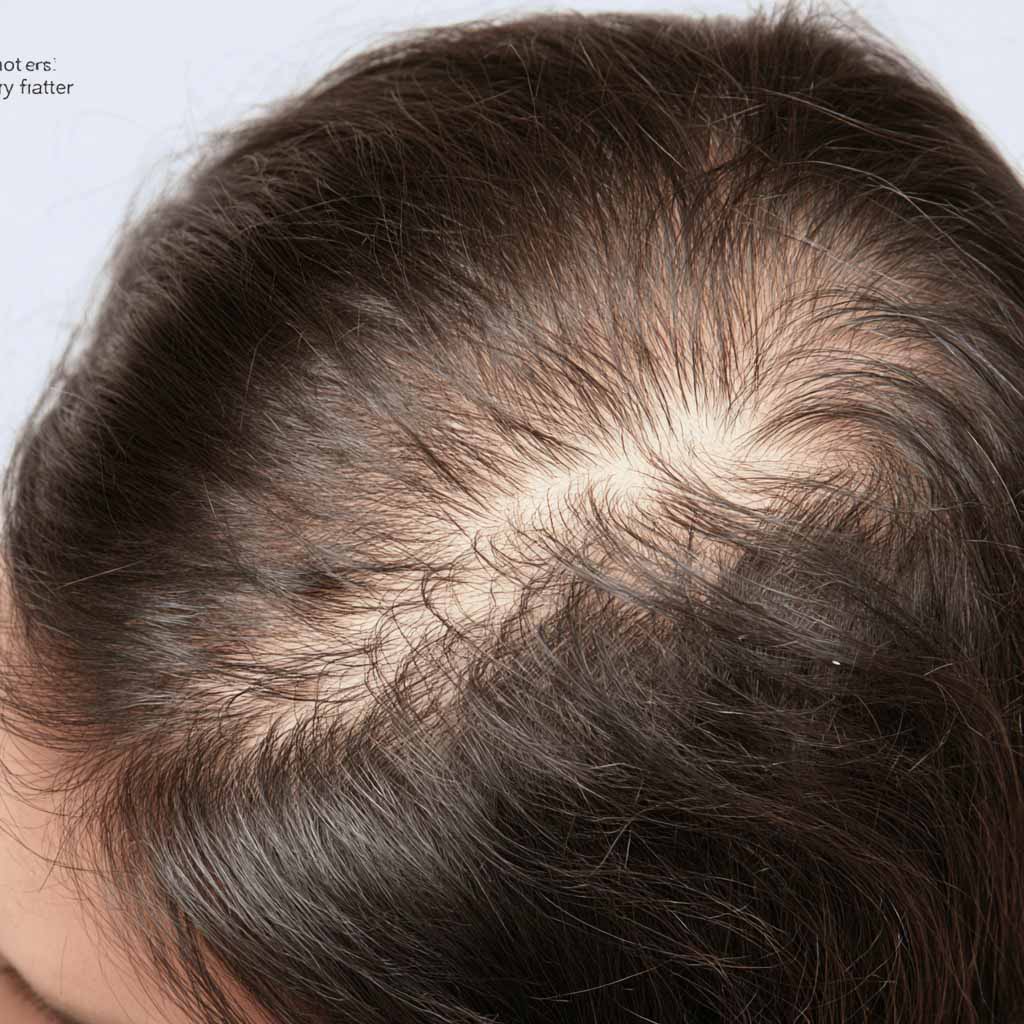
Both male and female pattern hair loss involve follicular miniaturisation, in which successive hair cycles produce progressively finer hairs. Their distribution and hormonal context differ.
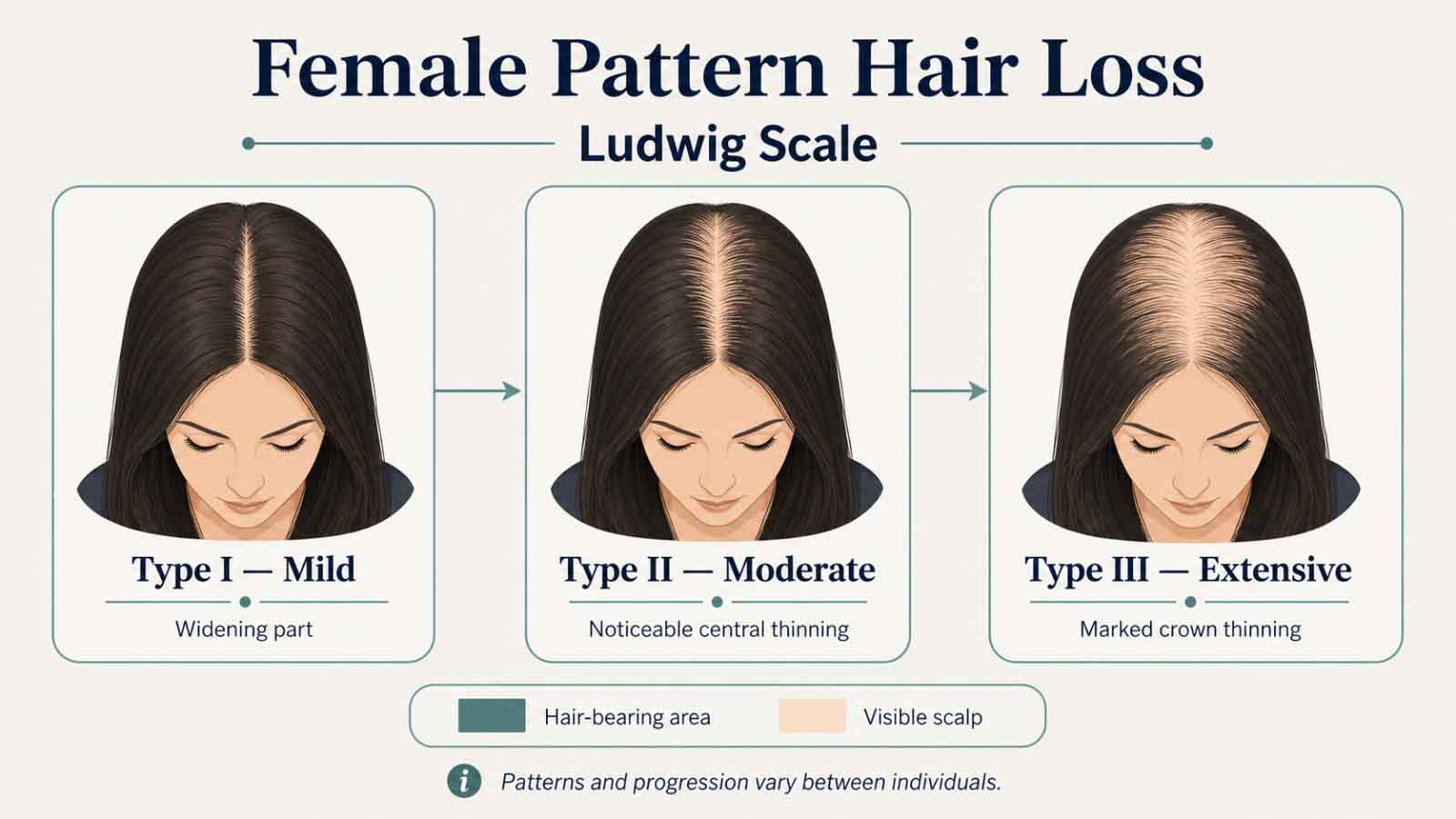
Distribution: Women commonly develop diffuse central thinning and widening of the midline parting, often with preservation of the frontal hairline; men more commonly develop bitemporal recession and vertex thinning.
Hormonal contribution: Dihydrotestosterone has an established role in male pattern hair loss. In FPHL, androgen contribution is less consistent, and normal serum androgen levels do not exclude the diagnosis.
Progression: FPHL usually progresses gradually. Complete scalp baldness is uncommon.
The Ludwig scale (Types I–III) is commonly used to describe the severity of FPHL (Ludwig, 1977).
FPHL is multifactorial. Potentially relevant factors include:
Telogen effluvium (TE) is a common cause of acute or subacute diffuse shedding in women. It may be distinct from FPHL, although the two conditions can coexist.
The normal hair cycle comprises anagen (growth), catagen (transition), and telogen (resting) phases. In TE, a higher proportion of follicles shifts prematurely into telogen, causing diffuse shedding. The shedding often becomes apparent two to four months after a trigger and may improve when the trigger is addressed (Malkud, 2015).
| Feature | Female Pattern Hair Loss | Telogen Effluvium |
|---|---|---|
| Distribution | Central scalp thinning or widening parting | Diffuse shedding across the scalp |
| Onset | Gradual and progressive | Subacute, often two to four months after a trigger |
| Course | Chronic; usually not spontaneously reversible | Often improves after the trigger is addressed |
| Trichoscopy | Hair-shaft diameter variation and miniaturisation may be present | May show increased telogen shedding without the typical pattern of miniaturisation |
Assessment may include:
Accurate diagnosis is important because management differs between FPHL, TE, and other causes of hair loss.
Contact via WhatsAppThe following describes possible approaches and their evidence base. Individual suitability, expected benefit, risks, and need for medical supervision differ between patients. No intervention guarantees a particular outcome.
Appropriate scalp cleansing may help manage sebum, scale, or concurrent scalp inflammation. It is not, by itself, a treatment for FPHL.
Low-level laser therapy (LLLT) uses red-light wavelengths, commonly around 630–660 nm. Proposed mechanisms include photobiomodulation of follicular cells. Randomised sham-controlled research has reported improvements in hair-related outcomes in women with pattern hair loss, but response and durability vary (Avci et al., 2014; Jimenez et al., 2014).
Tricopat is a device-based scalp-treatment platform combining controlled superficial skin patting or microdermal stimulation with pressure-wave and iontophoresis-based delivery; protocols may also include red LED exposure. Its proposed roles are to facilitate local delivery of an applied formulation and provide mechanical/electronic stimulation of the scalp.
In an open-label, non-randomised, single-centre study, Alessandrini and colleagues treated 60 individuals with androgenetic alopecia, including 30 women with associated telogen effluvium, using four sessions of preformed growth factors delivered after microdermal stimulation and iontophoresis at three-week intervals. Global photography and trichoscopy improved during follow-up. Among the female participants, anterior hair density increased by 13.97% and vertex hair density by 13.44% at six months. All participants completed treatment, and no serious adverse effects were reported (Alessandrini et al., 2021).
Tricopat may therefore be discussed as an adjunctive device-assisted approach, not as a replacement for evidence-based medical management.
Topical minoxidil is an established treatment option for FPHL. A randomised placebo-controlled trial reported hair-count changes with 5% and 2% topical minoxidil in women with FPHL (Lucky et al., 2004). Potential adverse effects, contraindications, and the need for continued treatment should be discussed with a registered medical practitioner.
Use of finasteride in women is more nuanced than in men and is generally considered only in selected clinical settings, such as some postmenopausal patients. Finasteride and related 5-alpha reductase inhibitors are contraindicated in pregnancy because of fetal risk; counselling and effective contraception are essential when relevant.
Hair transplantation relocates follicular units, usually from the occipital donor area, to areas of thinning. In women, suitability depends on disease stability, donor density, hair-loss distribution, and future hair-loss trajectory. Risks include bleeding, infection, scarring, and variable graft survival.
Scalp micropigmentation (SMP) is a cosmetic camouflage technique that deposits pigment in the superficial scalp dermis to reduce contrast between scalp and existing hair or create an appearance of density. It does not regrow hair.
Personalised care combining assessment, appropriate investigations, scalp care, and lifestyle guidance to support long-term scalp health and address early hair thinning or shedding.
• Maintain adequate dietary protein and address identified nutritional deficiency under clinical guidance.
• Avoid excessive chemical or traction-related hair practices.
• Seek medical assessment for progressive loss, acute diffuse shedding, scalp symptoms, or signs of androgen excess.
If you are concerned about hair loss, consult a registered medical practitioner for an individual assessment. This page is for general education only and does not constitute medical advice, diagnosis, or treatment recommendation.
This page is intended for general educational purposes only. It does not constitute medical advice, diagnosis, or treatment recommendation, and does not create a doctor–patient relationship. For assessment of your individual condition, please consult a registered medical practitioner.